This was a hell to get working.
- Record a very slow, well lit video of my room, from as many possible angles as possible.
- Spend 2 days compiling, testing, crying, about different gaussian splat software.
- Spend 4 hours converting it to a trained COLMAP dataset
- That is, extracting camera poses…
- Estimating depth maps…
- Matching landmarks…
- Finding linked poses…
- Spend 3 and a half hours actually training the splat…
So… I did it with my room,
This is just a first test of Gaussian’s, so I’ll have better ones soon. I need to figure out how to do scans with iPhone Pro nth gen, the lidar apparently makes it much faster (cuts out colmap step) and much better looking, since we’re not estimating depth maps.
I tried this with an old xbox 360 kinect, but the output was crap, it lost connection constantly, and who knows what else.
… but i reckon i could fix it up a bit, I never want to use ROS ever again.
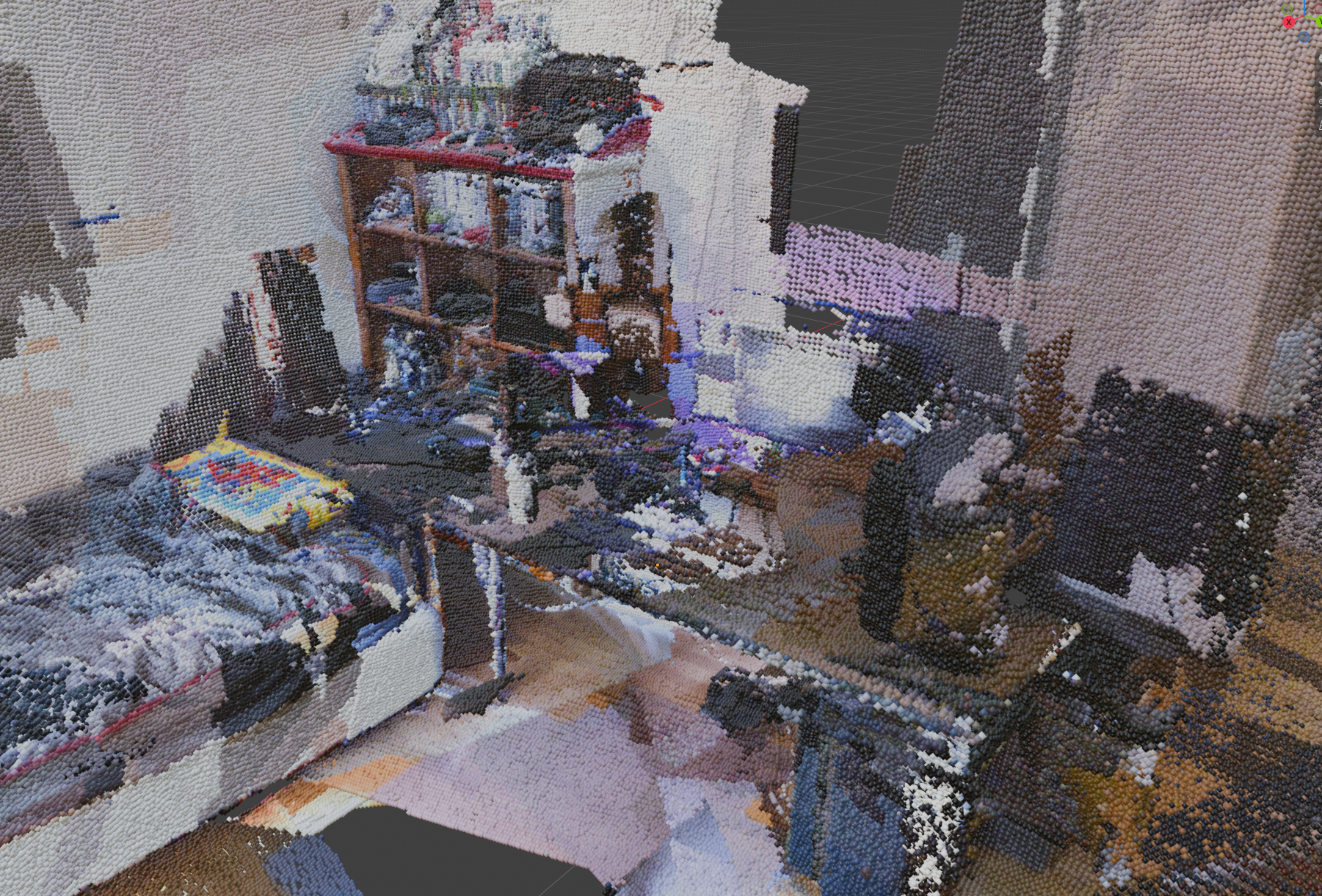
Yuck :/ what was i thinking back in 2024?
Anyhow, since I’m on linux AND with an AMD GPU, everything was slower, half broken, and almost no software worked…
except for Spirula Studio.
They have almost ALL Gaussian Splatting working, cross platform, and they do everything, converting video/photos to splat to mesh in one binary. How nice. (and I wasted a lot of AI tokens trying to get the others to work on the gfx1030, but since it’s missing a bunch of stuff, everything ran slow as hell)
Demo
This may take some time to load up the full splat. It tries its best to stream a small lod splat first, then the larger one as it can.
- lod1:
22MB - lod0:
102.6MB - raw ply file:
494.1MB - 9,251,457 ‘Splats’